
On April 22, Meta sent its entire workforce a memo.
The company was installing software on employee computers that would capture mouse movements, keystrokes, clicks, and screenshots in real time. The purpose was to train AI agents to perform white-collar computer tasks autonomously. Employees could not opt out.
As Gizmodo put it:
Workers are "essentially being told they are training the systems that will replace them."
Meta's stated rationale was direct: "If we're building agents to help people complete everyday tasks using computers, our models need real examples of how people actually use them." That logic isn't wrong. The problem is what it reveals about how Meta sees the relationship — and specifically, what they decided to take from employees.
What Was Actually Taken
There's a question gaining traction in conversations about AI and the future of work: who owns the AI agents you build while you're employed somewhere?
A recent piece in Forbes by Nirit Cohen, she makes a compelling argument. When you build AI systems around how you think — systems that learn how you structure decisions, weigh tradeoffs, and navigate your specific role — those systems begin to encode something more than productivity. The author describes them as "a digital extension of how you operate professionally." Not just a work tool. A career asset that accumulates over time and could, in theory, travel with you across roles. The expertise you've built over years gets encoded into a system that starts to look less like company property and more like an extension of you.
Researchers are starting to call this cognitive sovereignty — the idea that as AI systems encode the patterns of how you think and work, the question of who controls that becomes genuinely unresolved. One academic paper cited in the Forbes piece frames it as "meaningful control over systems that hold your thinking and decision patterns." No legal framework has answered this cleanly yet. But the recognition that it's a real question is growing.
Meta didn't pause for that question. Their employees' professional patterns — the way they navigate their tools, structure their work, and make decisions in motion — get captured, encoded, and handed to systems those employees had no say in building, won't own, and won't share the upside of except for very small employee stock shares for most.
That isn't just a policy decision. It's a statement about what Meta believes their people are for.
Why This Breaks Something Specific
To understand what's really at stake here — not just morally but practically — it helps to know what trust violations actually do, and why some of them don't heal the way others do.
Research from Wharton professors Maurice Schweitzer, John Hershey, and Eric Bradlow — published in Organizational Behavior and Human Decision Processes — found that not all trust violations are the same.
The first kind is an ordinary failure. Someone misses a commitment, doesn't follow through on something important. That kind of trust can be rebuilt — consistent, trustworthy behavior over time does it, and a genuine apology can help speed things along.
The second kind is an integrity violation. That's when the failure removes someone's ability to say no, or involves deception. The Wharton research shows this kind causes "significant and enduring harm." Trust "recovered more slowly and less completely," even with genuine effort — and in some cases, it didn't fully recover at all.
What Meta did falls into the second category — not because anyone lied, but because the employees had no option to decline. When you remove someone's ability to say no, you've crossed into what the Wharton researchers would call an integrity violation.
A mistake you can fix. A betrayal has a different timeline.
Research published in Psychology Today in late 2025 adds a physiological dimension to this. When trust breaks seriously, the nervous system responds as if a threat is still present — people become hypervigilant, scanning for the next problem before it arrives. Real repair, when it happens, takes six to twelve months of consistent, genuine effort from the company. And the research is clear: the company doesn't get to decide when trust is restored. That belongs to the people who were hurt.
That timeline assumes repair is happening.
Meta defended the program. No apology, no opt-in alternative, no acknowledgment that this decision was a different category of choice. For Meta's employees, the repair clock isn't running, it hasn’t started and might not ever start.
The Cost Nobody Is Counting
I watched a version of this play out at VMware, at a much smaller scale.
We had a pay equity program designed for a genuinely good reason — when employees relocated across regions, salaries adjusted to cost-of-living benchmarks, and to make it work, people had to self-report their location every quarter. The purpose was fair compensation.
What people couldn't let go of was the repetition. And for many that understood cost of living indexes, at a human level they still struggled to see that if they were doing the same work, why would they make less moving a couple of states, as their output was the same regardless.
Teams that had been delivering remotely for years would get the form again — and with it, the unspoken message that they needed to be checked again. "Why are you asking me again?" That feeling of being rechecked, of not quite being trusted despite a track record, built over time. The people who felt it most were the ones who had performed consistently without oversight, and were still being asked to re-prove where they lived, quarter after quarter.
Another big thing came up here, I went to the VP of HR during the Great Resignation with a simple point: we're cutting the salaries of the people we most want to keep. Someone I had worked closely with — a Wharton recruit who was one of the highest performers on her team — asked to move states. Her salary ran through the index and dropped. I pushed back hard. She left anyway.
Over 15,000 people moved through that program. All we were tracking was where someone slept.
Here's the question I keep coming back to: is a nervous system in protection mode where people innovate? Is that the state where someone brings their most creative thinking to a hard problem, or has the courage to raise a concern when something is going sideways, or goes beyond the minimum of what they're asked to do?
It isn't. Every leader knows it isn't. The best companies invest enormously in employee engagement precisely because the research is clear — it's what drives quality of work, retention, the willingness to take on hard things, and the kind of creative contribution that actually moves companies forward. Meta just put all of that at risk. Not quietly, and not by accident.
And the fear your people are carrying isn't abstract. They're not worried about AI in general. They're thinking about specific questions that don't have answers yet: will I still have a job on the other side of this? At what salary — and will it be enough? Will the work even be something I care about anymore? What does this mean for my kids? Will I be able to maintain my quality of life or will I have to make sacrifices?
The people who are supposed to be building AI transformation with you are making a decision every day about whether to lean in or protect themselves.
When that fear is already present — and you make an AI decision without explaining, without giving people a choice — you're not just creating a new trust problem. You're activating something that was already there.
The Version That Actually Works
Most people don't resist AI because they don't want to change. They want to be part of building something that matters — they want their expertise to count, their ideas to have a place, their contribution to be visible in what gets built. That instinct is an asset, and it's available to leaders who earn it.
What people resist is the feeling of being used rather than collaborated with.
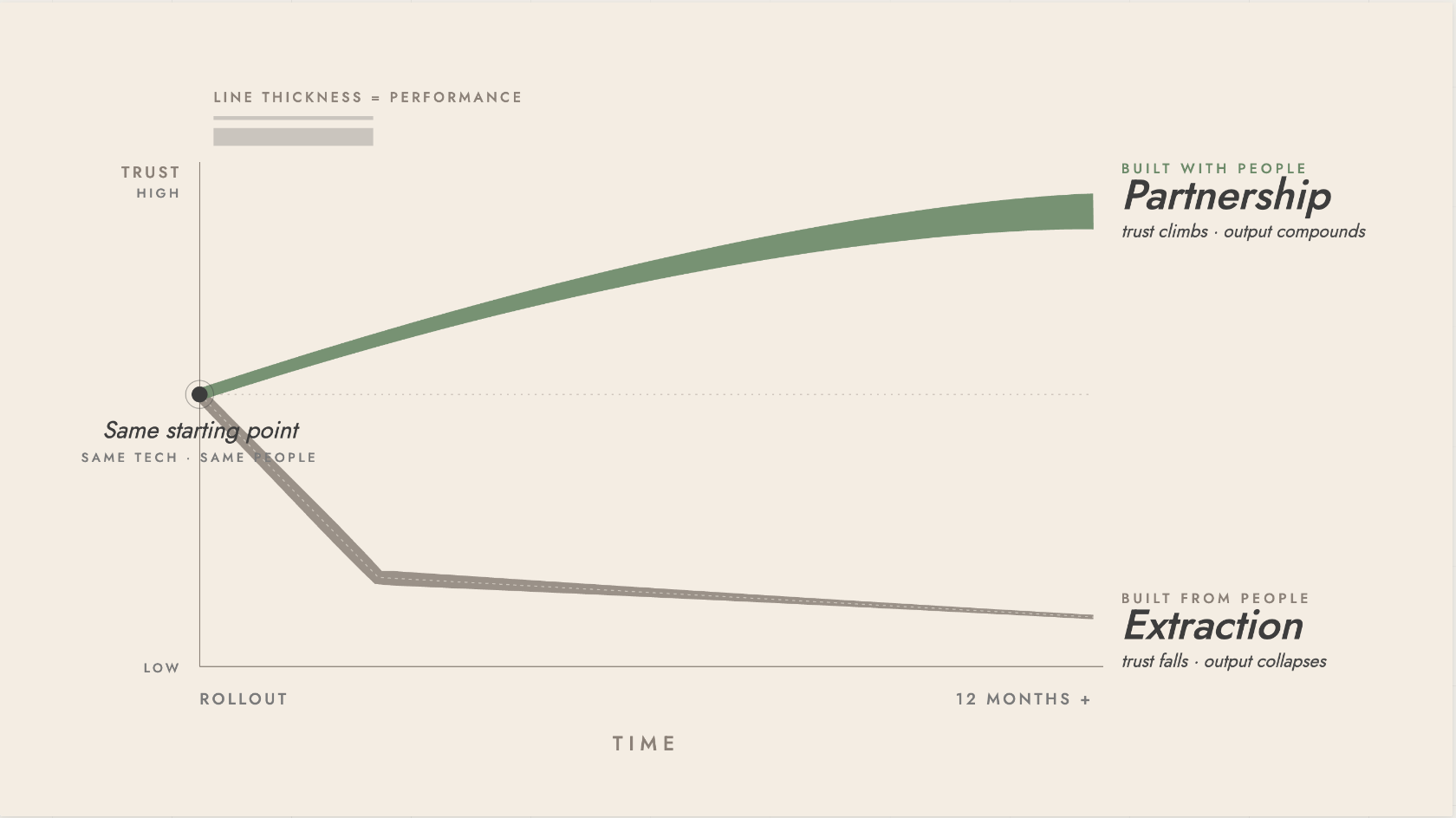
The companies that move fastest on AI won't be the ones who extracted the most from their people the quickest. They'll be the ones whose people genuinely wanted to help build it — because the relationship was there, because someone had done the harder work of figuring out what it actually means to build with people rather than from them, and when the time came, people felt like partners rather than subjects.
Think about what that kind of contribution actually requires. People have to bring their real expertise — their honest judgment, the way they genuinely navigate their work, the insights that only come from years of doing something well. You cannot mandate that. You can require someone to use a tool. You cannot require them to bring their best thinking to it. And in any real AI transformation, their best thinking is exactly what you need.
When employees can see their expertise being used to build tools that make them more capable — when the upside is visible and shared, when what's being built is something they'd have wanted to help build anyway — they stop thinking about protection and start thinking about possibility. They'll help improve what gets built. They'll catch what the AI gets wrong. They'll bring ideas that couldn't have come from anywhere else. That's not a nice-to-have. That's the whole thing.
The difference between those two outcomes isn't the technology. It's whether people felt like they were a part of it.
This Isn't a Design Problem
The easy lesson here is process: build better opt-in frameworks, run cleaner pilots, get the communications right.
That's the design answer, and it misses what's underneath.
What happened at Meta — and what happens every time fear wins an AI decision — isn't a process failure first. It's a principles failure. The process reflects what a company actually believes about its relationship with its people. If the operating principle underneath is "we need this and we're going to take it," no rollout plan repairs what that signals.
The leaders navigating AI transformation well aren't doing it because they engineered better consent mechanisms. They're doing it because they genuinely understood what they were asking for — which is a great deal — and they showed up in a way that made it safe to give.
Your people are trying to figure out what their work life looks like on the other side of this. They've built their expertise and their sense of who they are around knowing how to do something well. They're not afraid of change. They're afraid of what this specific change means for them — and they're watching every decision you make to understand which side you're on.
How you show up in those decisions — what you explain, what you protect, what you ask rather than take — is what tells them.
You can mandate the tools. You cannot mandate the trust.
The fastest path is the one your people actually wanted to take.
Sources
"Mark Zuckerberg Just Sent a Shocking Message to Meta Employees" — The Street, April 22, 2026
"How Long Does It Really Take to Heal After Betrayal?" — Psychology Today, December 2025
"Can You Take Your AI Agents With You When You Leave A Job?" — Forbes, April 18, 2026
Oh and congrats,noticed you’re starting out here
Thank you for co creating with me. I noticed readers landed on my Forbes column from your newsletter. Do you believe AI Agents will end up part of what we professionally own as individuals ?