
If you're leading a team through an AI transformation right now, you're probably feeling it from both directions. The pressure from above to move faster — and the quiet uncertainty rippling through your team about what any of this actually means for them. Most of the conversation happening around you is about the technology: which tools, which platforms, which rollout timeline, which adoption metrics show you're moving fast enough.
What I want to talk about is the thing underneath all of that. The foundation that determines whether any of it actually works. After watching organizations try to do this, reading the research, and sitting with what I know about how people change — I'm convinced most organizations haven't built it yet.
The research points in a consistent direction. When managers visibly model AI use, employees show a 30-point lift in trust toward AI systems, according to the 2026 Microsoft Work Trend Index. That's not a training gap or a communication problem. The variable is who's leading — and how.
Meanwhile, teams are already moving without the official rollout. Between 78% and 86% of employees now use unapproved AI tools at work, regularly, because they've stopped waiting for their organizations to give them what they need. That ground-up movement is real and promising — and whether it becomes genuine transformation or fragments into isolated pockets of productivity depends almost entirely on what leaders do next.
BCG research put numbers to the gap: 76% of executives believed their employees were enthusiastic about AI adoption. The real number was 31%. Something is getting lost in translation — and it's getting lost at the manager layer.
The technology is not the constraint. The foundation is.
Before you keep reading: the framework below has four layers and more components than any one leader should try to change at once. Hold this as your lens — pick one trait from whatever layer lands for you, and give it a week. I wrote this for you so that you have a road map for what's actually important right now.
What Google Learned About Management
In 2008, Google launched Project Oxygen — an initiative to find out whether managers actually mattered. In a company built around brilliant engineers, the working assumption was close to the opposite: did management add real value, or just get in the way?
They analyzed 10,000 observations across thousands of employees — performance reviews, surveys, top-manager nominations — and ranked manager behaviors by their actual correlation with team outcomes. The results surprised everyone, starting with Google.
Technical skills ranked last. Dead last, out of eight behaviors.
The behavior that ranked first? Being a good coach.
Google's engineering culture had assumed the best managers were the ones who knew the most. What the data showed was that the best managers were the ones who asked good questions, invested in their people's development, communicated clearly, and listened — who showed up as human beings in relationship with other human beings, not as technical validators.
By 2018, Google revisited the list, expanding it from eight behaviors to ten. The two they added — collaborating across boundaries and being a strong decision-maker — turned out to be highly correlated with better team outcomes. The coaching still came first. The technical skills stayed last.
In 2026, a parallel shift is underway. The conversation about AI leadership has been dominated by questions of technical fluency — who understands the tools, who can speak the language. But Ethan Mollick, after running an experiment in which MBA students built functional startup prototypes in four days using AI, wrote something that stays with me: "The skills that are so often dismissed as soft turned out to be the hard ones." The students who succeeded weren't AI experts. They were people who already knew how to scope a problem, define what good looked like, and recognize when something was off. Management skills, it turns out, are AI skills.
The traits that make managers effective during AI transformation are not primarily technical. They are relational, emotional, and cognitive.
The Crisis Hiding in Plain Sight
Gallup's State of the Global Workplace 2026 released numbers that should give every executive pause. Manager engagement has fallen nine points since 2022 — down to 22% globally, the steepest sustained decline of any employee group Gallup tracks. In the United States, overall employee engagement has hit a 10-year low. And Gallup's decades of research on what drives team performance points to a single conclusion: managers account for 70% of the variance in team-level engagement.
The people who are supposed to be creating the conditions for AI adoption are running on empty.
This isn't just a morale problem. It's structural. HBR Study found Middle managers — the people closest to where AI transformation actually happens — feel less psychological safety than any other group in the organization. Less safe than the C-suite. Less safe than their own direct reports. They sit in the middle of every organizational decision, absorbing pressure from above and translating it downward, often without a coherent narrative to offer their teams.
The gap between what the executive floor believes and what the manager layer is actually living has never been more costly to ignore.
What You're Up Against
Fear is the most expensive thing your organization is probably not measuring.
The fears employees are carrying right now are specific, not abstract. Trust in a direct manager is the strongest single predictor of whether an employee engages with organizational change — and the fear most people are navigating is concrete: Will I still have a job? Will I still be good at it? Will what I've spent years building still matter?
That fear doesn't announce itself. It shows up as compliance without contribution — people doing the minimum to appear AI-capable while protecting themselves from what they don't trust. Stanford psychologist Jamil Zaki, writing in HBR, noted that nearly a third of employees — and 44% of Gen Z workers specifically — admit to actively sabotaging their company's AI strategies. This is a rational response to feeling like the organization is not on your side.
At the Human+Tech conference in San Francisco, I heard John Hagel — whose book The Journey Beyond Fear traces what actually moves people through resistance — name the core tension: most people, looking at the future right now, see it as a threat. What overcomes fear isn't reassurance. It's the experience of having impact. People who can see their contribution mattering stop scanning for threats and start looking for possibilities.
Leaders who name the fear — who acknowledge it explicitly rather than manage around it — are doing something most leaders aren't: addressing the actual constraint.
And at a personal level, as a leader, the anxiety you haven't processed will travel downstream. That's not a leadership theory. That's just how rooms work. Burned-out managers produce disengaged teams, and disengaged teams do not build AI transformation.
What the Research Points To
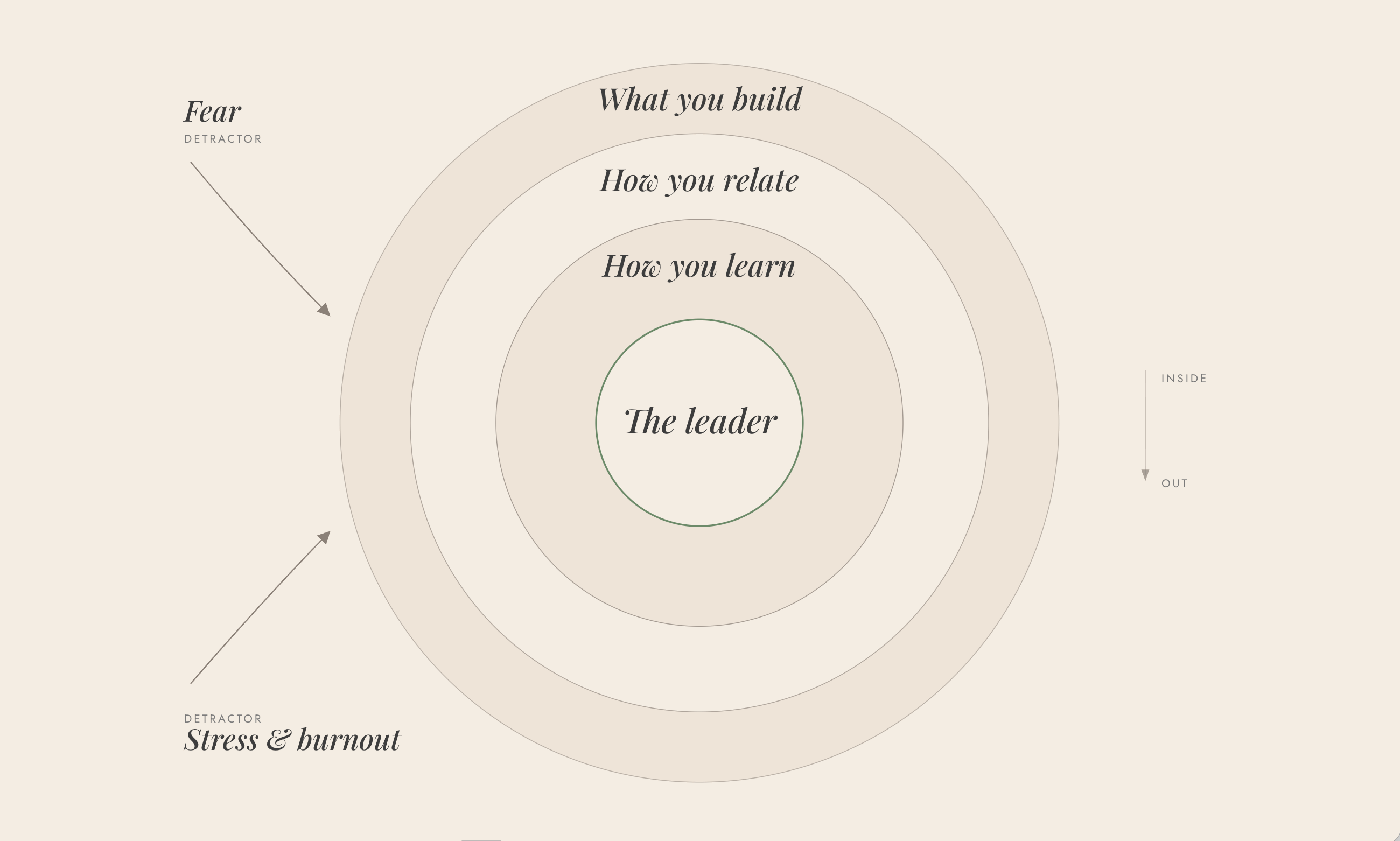
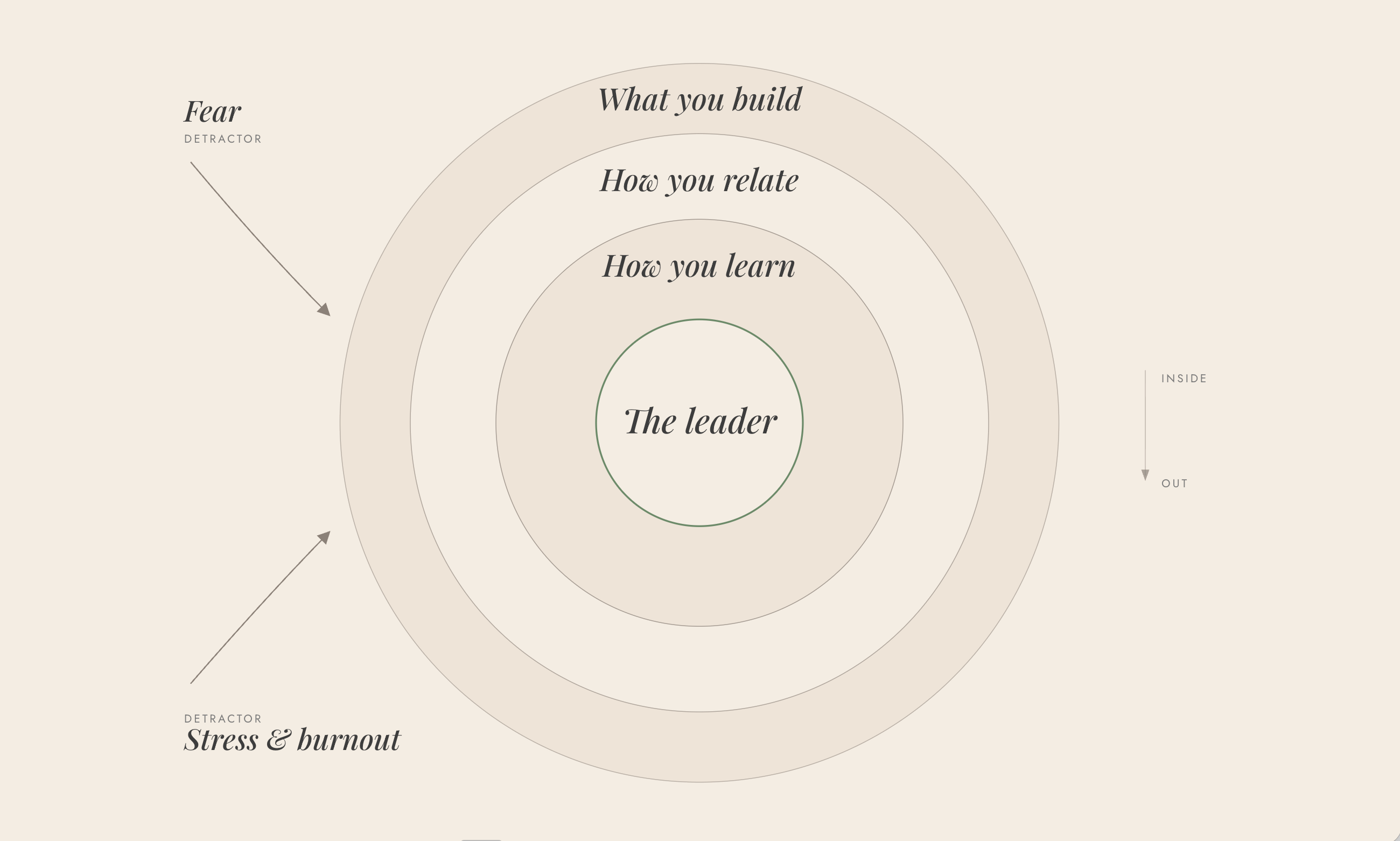
The traits that matter for AI transformation leadership build in layers — each one enabling the next, inside out. Layer 1 is who you are. From there, how you learn, how you relate, and what you build follow.
Not all of this is equally in your hands. Some of what lives in the outer layers — team structure, autonomy, space to experiment — depends on what's above you. That's real. But the layers closest to the center are yours regardless of what the org chart says. And those are the ones that change the room.
Layer 1: Who You Are
This is the center — and the layer most organizations completely ignore.
Before what you do as a leader, there is who you are. The inner state you bring into the room. The stability underneath your decisions. The degree to which you've examined your own relationship to uncertainty, change, and not knowing.
Three things live here that matter enormously right now.
Passion is the most underrated. Not enthusiasm performed for an audience — genuine care about something. The work, the people, the possibility of what AI could open for your team. John Hagel's research on what he calls the passion of the explorer shows that leaders with this quality approach obstacles differently: their first instinct when they hit a wall is to find who else can help them get to a better answer faster, rather than to protect themselves. That orientation is contagious in both directions. Fearful leaders create fearful teams. Curious leaders create curious teams.
Growth mindset is the orientation that makes everything else possible. Carol Dweck's decades of research at Stanford and mindset book established that the belief our abilities can develop — rather than being fixed — fundamentally changes how people respond to challenge, failure, and uncertainty. In this moment, leaders with a growth orientation try things, share what they learned, and make it safe for everyone around them to do the same. Leaders without it tend to protect what they know and avoid what they don't.
Staying grounded under pressure is the competency almost no leadership curriculum addresses, and everyone needs it right now. The anxiety you haven't processed will travel downstream — your team feels it before you've said a word, and it shapes every decision you make when you're running on empty. The ability to be where the anxiety stops, rather than the channel through which it moves, is what keeps you curious, present, and open when your team needs you to be.
Layer 2: How You Learn
This is what your team is actually watching. Not what you say about AI — what you do with it. Whether you admit what you don't know. How you respond when something doesn't work.
The most important finding from the 2026 Microsoft Work Trend Index on what separates high AI performers from everyone else isn't which tools they use. It's that their managers are openly learning alongside them. When a leader shares what they tried and what didn't work, asks their team what they're discovering, and admits what they don't yet understand — that behavior creates permission at scale.
Ryan Vauk, who leads AI transformation at Google, described the shift at the Human+Tech conference: the managers making AI transformation real are moving from expert to catalyst, from analyst to storyteller, and — most importantly — from demonstrating perfection to demonstrating courage. In a world where no one yet knows the right path, the leader willing to not have all the answers is more valuable than the one who projects certainty they don't have.
Curiosity is the antidote to fear. The most important practice right now is using AI yourself — openly, imperfectly, in front of your team. That's what gives everyone around you permission to do the same.
Layer 3: How You Relate
This is where people decide whether it's safe to bring their whole selves. Empathy, trust, psychological safety, credibility, motivation, confidence — these are the relational conditions that determine whether your team contributes their real expertise or holds back.
Empathy is the one executives are most visibly abandoning right now — and the cost is measurable. A 2021 Catalyst survey found that 61% of employees with empathic managers reported actively innovating at work, compared to just 13% of employees whose managers were not empathic. The gap isn't personality. It's safety.
Psychological safety is the bedrock — and AI is creating new ways to erode it. When AI provides confident but incorrect information, teams don't just lose trust in the AI — they start losing trust in their own judgment. Harvard Business School professor Amy Edmondson calls this "trust ambiguity" — and it's one of the more insidious dynamics happening inside teams right now.
Motivation is the trait most connected to what Project Oxygen actually found. Coaching ranked first — and at its core, good coaching is about helping someone see why their work matters, not just requiring them to do it. In a moment when people are genuinely asking whether their contribution still has value — whether AI has made them less necessary — a leader who can help someone see what only they bring, what can't be replicated or prompted, is doing something that has always mattered and now matters enormously.
Confidence-building means helping your team separate skill-building from identity threat. ManpowerGroup's 2025 data found AI usage increased 13% while confidence in using those tools dropped 18% in the same period. Three-quarters of employees don't feel confident. What's happening underneath: people can't distinguish between "I'm not yet confident using this tool" and "I'm losing my professional edge."
One is a skill gap. The other is an identity threat.
Managers who can name that difference clearly — who can say "your expertise hasn't diminished, you're adding a new layer on top of it" — are doing something that directly determines whether people bring their judgment to AI work or just comply with the output.
Layer 4: What You Build
These are the structural and cultural choices — what the manager actively creates, protects, and measures for their team.
Collaboration over silos. Deloitte's 2026 research on AI and team structure found that high-trust teams use AI at 83% rates versus 63% for lower-trust teams, and cross-functional teams are 30% more likely to report significant efficiency and innovation gains. The manager is the structural orchestrator of whether people build on each other's work or protect their own lane. As Rosanna Durruthy observed at the conference: the teams that will matter most are the ones designed to need each other — where AI creates interdependence rather than isolation.
Autonomy. The ground-up AI movement happening right now is powered almost entirely by it. For the first time, people have tools they don't need to write a business case for — automation at their fingertips without asking permission. Teams given the autonomy to reorganize their work in ways that make sense for them are building genuine capability. Teams waiting for the approved rollout are falling behind.
Space to learn and innovate. Almost all AI investment goes to the technology itself — next to nothing goes to training and culture. The manager is the one who decides whether the time that learning actually requires gets protected or consumed by run-rate demands. John Hagel's model: small impact groups of three to fifteen people, given time and space to learn together and create new knowledge. The organizations that accelerate won't be the ones with the best tools — they'll be the ones with the most deliberate learning cultures, where experimentation is rewarded and failure is information rather than evidence of poor judgment.
This Isn't Just Change Management
Here is what I believe after watching organizations try to do this: most of them are approaching it backwards.
The conversation is almost entirely about what AI is going to do — to jobs, to workflows, to industries, to people's sense of who they are at work. And that conversation is real and worth having. The best leaders I'm watching right now have flipped the question. They're not primarily asking what AI is going to do to them or their teams. They're asking who they're going to be while it happens. How they're going to show up.
Change management matters. The communications plan, the rollout sequence, the champions structure — all of it is necessary. But it isn't sufficient. Change management puts the leader outside the process, architecting it toward a desired outcome. What this moment requires goes further than that. It's being in it with your team, not orchestrating them through it. It's showing up like a good human being — honest about what you don't know, genuinely curious about what's possible, willing to model the learning rather than perform the confidence.
And that learning has to be real. Leaders need to actually use AI — not delegate it, not observe it from a distance, not wait until they've mastered it before showing their team. The most powerful thing a leader can do right now is be visible in their own learning curve. Use a tool in front of your team. Share what surprised you. Say out loud what you tried that didn't work. That's not vulnerability for its own sake. That's the signal that tells everyone around you it's safe to do the same.
Leadership in most organizations was already flawed before AI arrived. AI doesn't create the gaps — the identity tied to having answers, the anxiety passed downward, the need to project confidence that isn't there. It just makes those gaps more visible and more costly.
The leader who doesn't do this doesn't just fall behind on adoption. They lose their credibility — the specific credibility that comes from being willing to do what they're asking their people to do. You're asking your team to grow publicly, to learn while uncomfortable, to stay curious when it's hard. If you won't go first, the ask doesn't land. It just becomes one more thing being done to people who are already overloaded.
Your people are watching every decision you make for signals about which side you're on. Whether it's safe to struggle. Whether it's safe to not know. Whether trying something that doesn't work will be held against them. Whether their expertise still matters. Whether you see them.
The most important thing you can do right now isn't to have the right AI strategy. It's to be the kind of leader who makes it possible for the people closest to the work to bring what they actually know to building it.
Pick one trait. Give it a week. Show your team what it looks like when the person who's supposed to have the answers is still learning.
That has never been a design question. It's always been a leadership one.
Sources
Google Project Oxygen (HBR, Dec 2013)
State of the Global Workplace 2026 (Gallup)
Managers Account for 70% of Variance in Employee Engagement (Gallup)
Middle Managers Feel the Least Psychological Safety at Work (HBR)
Work Trend Index Annual Report 2026 (Microsoft)
Empathetic Leadership Can Make or Break AI Adoption — Jamil Zaki, HBR April 2026
Bridging the AI Value Gap: Are Team Dynamics the Missing Link? (Deloitte, Feb 2026)
The Journey Beyond Fear — John Hagel
Management as AI Superpower — Ethan Mollick, Substack, April 2026
Human+Tech Conference, San Francisco, May 2026 — John Hagel, Ryan Vauk, Rosanna Durruthy