
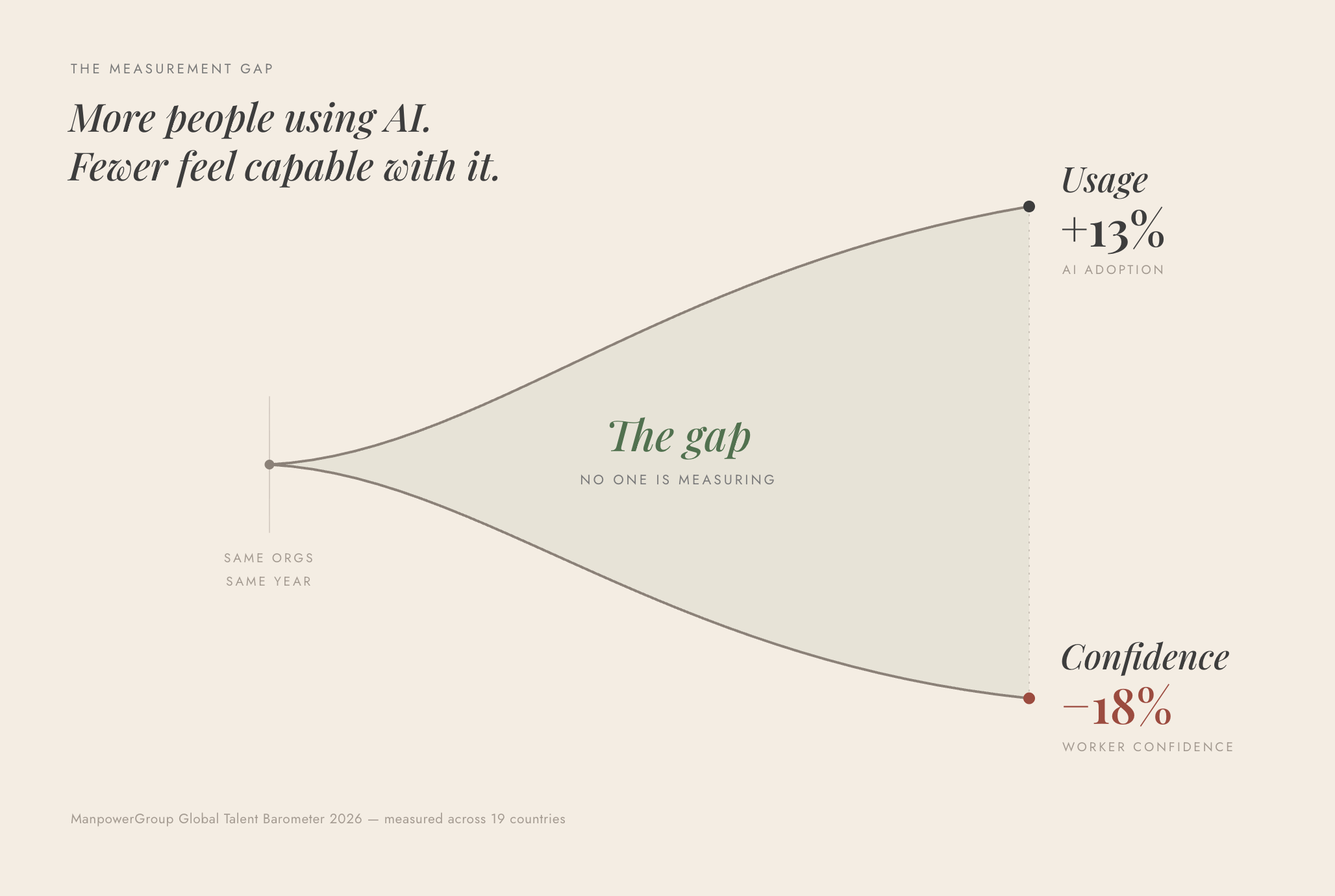
ManpowerGroup measured AI adoption across 19 countries last year. Usage went up 13%. Confidence went down 18%. At the same time, in the same organizations.
More people using AI. Fewer people feeling capable with it.
That's not a rollout problem. That's a measurement problem. Nobody was watching the right things.
Michael J. Jabbour, AI Innovation Officer at Microsoft's Office of the CTO, frames it plainly: data is what makes you outcome-oriented. It tells you whether your activities, your initiatives, your programs are actually producing the results you want — or just producing activity. In AI transformation, the results most organizations track can look exactly right while the human layer underneath moves in the wrong direction.
HBR found productivity and psychological engagement moving in opposite directions under AI adoption — output up, motivation down. Upwork found the most productive AI users are nearly twice as likely to report burnout and twice as likely to consider quitting. The people driving your transformation numbers may be your highest flight risk.
You cannot protect what you cannot see.
Here is what measuring the right things actually looks like.
The Human Layer Assessment is twenty questions and a 1–5 scale. Take it before transformation begins. Take it again in a month — or after 90 days of active AI use if you're mid-program. The gap between the two scores is your actual data — which cluster moved, which didn't, where to focus.
Three Clusters
The questions fall into three clusters.
Conditions — what needs to exist before transformation can take hold: buy-in, inner orientation, learning culture, relational quality of the team.
Outcomes — what transformation is doing to your people: whether capability is building, whether work still feels meaningful, whether the pace is sustainable.
Reach — whether what your people are learning is actually spreading to the team, through shared practices, human connection, and collective standards for what good work looks like.
One screening question first, on the same 1–5 scale:
How actively are you currently using AI tools in your work? 1 = Not at all yet → 5 = Central to how I work every day.
This isn't scored. It segments your data. A team of early-stage users tells you something different from a team of daily users. You need to see that distinction in the results.
Score each cluster separately. The pattern across all three tells you more than any single question.
Rate each statement 1–5: 1 = Strongly Disagree → 5 = Strongly Agree
How to Run It
Send it to your team and run it anonymously. When people don't feel safe being honest, they answer in a way that sounds right — not in a way that's true. Anonymity is what makes the data usable.
This runs best when HR or a People leader owns administration and a senior leader owns acting on the results. Without someone accountable for both, scores sit in a deck.
If you want a directional read before committing to all twenty questions, start with Q1, Q8, and Q13. Those three — taken together — tell you whether the conditions, the culture, and the capability are present. If all three score low, you know where to begin. If one scores low, you know which cluster to prioritize.
Include a role or function field — not a name. That one extra question lets you see whether different parts of the organization are having different experiences. Without it, you only get one number for everyone — and a team that's struggling won't show up.
Conditions
The Conditions cluster measures the foundation underneath everything else: whether people understand why AI is happening, whether they feel ownership over it, whether the environment supports learning, and whether the team trusts each other. When no one explains the real reason, people fill in the blank themselves — and right now, the default answer is replacement.
Buy-in and Agency
Q1. I understand why my organization is adopting AI — not just that it is.
HBR found employees perceive AI as a direct threat to their competence, autonomy, and sense of belonging — before a single tool is introduced. BCG found leaders believed 76% of their employees were enthusiastic about AI adoption. Actual enthusiasm was 31%.
That 45-point gap lives here. This question measures whether the foundation for genuine buy-in exists — not whether the announcement happened, but whether it landed.
Q2. I feel in control of how AI gets used in my work.
Agency is what separates people who build with AI from people who comply with it. As AI systems encode how you think and work, who controls that is genuinely unresolved. Microsoft's Work Trend Index found only 13% of workers feel rewarded for reinventing how they work with AI. Low scores here mean AI is being done to people. High scores mean they feel ownership over how it shows up in their work.
Inner Orientation
Q3. I believe my ability to work with AI will improve the more I practice it.
Growth mindset is the strongest predictor of persistence through difficulty. When tools change and learning gets hard, this is what keeps people moving forward. HBR found only 5% of employees qualify as sophisticated AI users. The belief that capability grows with practice is what gets people there.
Q4. Learning to use AI feels like something I'm choosing, not just something I have to do.
Intrinsic motivation determines depth of adoption. Someone who feels ownership over their AI learning explores, experiments, and finds real applications. Someone going through the motions uses AI the way it came out of the box. BCG found that with strong leadership support, employee enthusiasm rises from 15% to 55%. This measures the starting orientation that support either unlocks or can't overcome.
Q5. I can stay focused and calm when AI creates confusion or uncertainty in my work.
AI creates real uncertainty — outputs surprise, tools change, workflows break. HBR found cognitive overload from AI oversight measurably degrades performance. Whether someone can stay regulated in that moment — rather than spiraling or reverting — is what determines whether learning compounds. This measures the emotional foundation underneath everything else.
Learning Culture
Q6. My manager shares what they're learning about AI, including when things don't go as expected.
This is modeling — the visible, imperfect practice of learning in front of the team. It is not the same as development, which Q10 measures.
Microsoft's Work Trend Index found that when managers openly model their own AI learning — including failures — employee trust increases 30 points. When managers perform expertise instead, they signal that not-knowing is dangerous. That signal shuts down experimentation across the whole team before it starts.
Q7. I know where to turn when I get stuck with AI.
People who hit a wall with no path forward revert. Gallup found less than one-third of employees in AI-implementing organizations say their manager actively supports their AI use. This doesn't have to be the manager — it can be a champion, a peer, a resource. It measures whether the infrastructure for getting unstuck exists at all.
Relational Culture
Q8. I feel safe trying things with AI here, even when I'm not sure they'll work.
Psychological safety is the condition that makes everything else possible. Without it, people perform adoption rather than build it. MIT Technology Review found 83% of executives say psychological safety measurably improves AI initiative success. This measures whether that safety is felt at the individual level — not assumed from above.
Q9. My team trusts each other's judgment, even as AI changes how we work.
Deloitte found high-trust teams use AI at 83% versus 63% for lower-trust teams — a 20-point adoption gap driven entirely by the relational environment, not skill or access. Trust also keeps teams from fracturing as adoption speeds differ across the group.
Q10. My manager actively supports my development through this AI transition.
Development is what managers do for you — actively investing in your growth, treating this as a human development opportunity, not a technology deployment. That is different from modeling, which is what they do visibly in front of you. Both matter. They are not the same thing.
Microsoft found employees report significantly higher AI readiness when managers actively develop them — not just encourage them to use tools. Low scores here tell you the program is being treated as a rollout. That distinction changes the outcome.
Those are the conditions. What comes next is what transformation is doing to your people.
The Layer Nobody Else Is Measuring
The Outcomes cluster measures what transformation is actually doing to your people — whether capability is building, whether work still feels meaningful, whether the pace is sustainable.
Capability and Judgment
Q11. I know how to direct AI to get useful results — not just generic ones.
Before confidence, before calibration — can someone get AI to produce something specific and useful for their actual work? Low scores mean adoption is wide but shallow. People are using AI the way it came out of the box, getting generic outputs, and moving on.
Q12. I feel confident using AI to get results that actually help me do my job.
ManpowerGroup found usage up 13%, confidence down 18% — simultaneously. More use is not more capability. This is the leading indicator of whether adoption deepens over time or plateaus.
Q13. I trust my judgment to recognize when AI output is wrong or needs correction.
The human backstop. HBR found AI output passed downstream without human review affects 41% of knowledge workers and costs roughly two hours of rework per instance. Whether people trust their own judgment to catch AI errors is what separates practitioners from users. Watch this delta closely post-program.
Q14. I can tell when it makes sense to use AI versus when I should handle something myself.
Calibration is the core judgment skill of AI-era work. Over-delegating produces cognitive atrophy. Over-involving yourself when AI could handle it causes burnout. HBR found that because AI now handles the repetitive tasks that once built judgment, people miss the formative practice. This measures whether that calibration exists.
Role Identity
Q15. My work still feels meaningful, even as AI handles more tasks.
HBR found productivity and psychological engagement moving in opposite directions — output goes up, motivation goes down. Meaning sustains engagement beyond the initial excitement. A drop here from pre to post signals transformation producing output without building the human outcomes that make it last.
Q16. AI is expanding what I can contribute, not replacing the judgment my role requires.
There are two ways AI changes what people contribute. HBR found that when people use AI as a reasoning partner — thinking about their thinking, not just producing faster — it expands what they can contribute. When they don't, output goes up but the distinctiveness of their thinking declines. This question measures which direction AI is moving people.
Wellbeing
Q17. I manage my energy well when doing cognitively demanding work.
Upwork found the most productive AI users nearly twice as likely to report burnout and twice as likely to consider quitting. HBR found AI introduced continual attention-switching and a growing number of open tasks — less time, not more. This catches the sustainability signal before it shows up in attrition.
Individual Gains Stay Individual
The Reach cluster measures whether what your people are learning is actually spreading to the team — through shared practices, human connection, and collective standards for what good work looks like.
Q18. My team shares what's working — including what didn't — not just polished final results.
Microsoft's research found AI doing to collaboration what remote work did — removing the functional dependencies that once required people to reach out to each other. Individual AI gains are real. Without a sharing culture, they stay individual. This measures whether organizational learning is actually happening.
Q19. I seek out colleagues' perspectives even when I could get an answer another way.
HBR found 74% of knowledge workers now use AI for at least one form of support they used to get from colleagues. Ju and Aral at MIT found human-AI teams communicate significantly less social and emotional content over time — they produce more but build less together. This measures whether human connection is still being chosen. That choice is what keeps collaboration capital from depleting.
Q20. My team has clear standards for what good work looks like.
HBR found that without shared quality standards, AI output erodes trust between team members — people can't distinguish someone's real thinking from something passed through a tool unchecked. Microsoft found teams that discuss AI quality standards are significantly more likely to be in the high-performing group. Standards are what make collaboration sustainable as AI changes what the work looks like.
What the Scores Tell You
Average the responses within each cluster. Your result is still on a 1–5 scale. Score each cluster separately. These are signals, not verdicts. The point of this assessment isn't to grade your organization — it's to show you where to focus.
Low Conditions — focus here first, before investing more in tools or training. Everyone feels the urgency to move on AI. This score tells you that the foundation — the why, the safety to experiment, the trust in the team — needs attention before anything else will land the way you want it to.
Low Outcomes — transformation is producing activity without building the human results that make it sustainable. People may be using AI more and growing less. That's a work design problem, not a training problem.
Low Reach — individual gains are staying individual. What one person figured out isn't moving to the team. Champions, shared standards, and structured knowledge sharing are the levers.
Low across all three — start with Conditions. You cannot build Outcomes or Reach without the foundation.
High across all three post-program — your people came through more capable, more engaged, and more connected than when they started. That's the outcome worth designing for.
The specific work practices that move each of these scores — what leaders, managers, and teams can do differently — are covered in the next article in this series.
The Data Already Exists — Inside Your Team
You can run this today. Before any formal program. Before you've spent anything on transformation. With your existing team, on your existing tools.
Take it now. Take it again in a month — or after 90 days of active AI use if you're mid-program.
The organizations that will get AI transformation right aren't the ones with the biggest budgets. They're the ones who knew where their people started and where to pivot.
The Assessment
Screening question (unscored, 1–5): How actively are you currently using AI tools in your work? 1 = Not at all yet → 5 = Central to how I work every day
Rate each statement 1–5: 1 = Strongly Disagree → 5 = Strongly Agree
Conditions
Q1. I understand why my organization is adopting AI — not just that it is.
Q2. I feel in control of how AI gets used in my work.
Q3. I believe my ability to work with AI will improve the more I practice it.
Q4. Learning to use AI feels like something I'm choosing, not just something I have to do.
Q5. I can stay focused and calm when AI creates confusion or uncertainty in my work.
Q6. My manager shares what they're learning about AI, including when things don't go as expected.
Q7. I know where to turn when I get stuck with AI.
Q8. I feel safe trying things with AI here, even when I'm not sure they'll work.
Q9. My team trusts each other's judgment, even as AI changes how we work.
Q10. My manager actively supports my development through this AI transition.
Outcomes
Q11. I know how to direct AI to get useful results — not just generic ones.
Q12. I feel confident using AI to get results that actually help me do my job.
Q13. I trust my judgment to recognize when AI output is wrong or needs correction.
Q14. I can tell when it makes sense to use AI versus when I should handle something myself.
Q15. My work still feels meaningful, even as AI handles more tasks.
Q16. AI is expanding what I can contribute, not replacing the judgment my role requires.
Q17. I manage my energy well when doing cognitively demanding work.
Reach
Q18. My team shares what's working — including what didn't — not just polished final results.
Q19. I seek out colleagues' perspectives even when I could get an answer another way.
Q20. My team has clear standards for what good work looks like.
Sources
ManpowerGroup Global Talent Barometer 2026
HBR "Research: Gen AI Makes People More Productive — and Less Motivated"
HBR "Why Gen AI Feels So Threatening to Workers"
HBR "What the Best AI Users Do Differently"
HBR "When Using AI Leads to Brain Fry"
HBR "How Do Workers Develop Good Judgment in the AI Era?"
HBR "AI-Generated Workslop Is Destroying Productivity"
HBR "Employees Are Relying on AI for Personal Support. That's Risky."
HBR "AI Doesn't Reduce Work — It Intensifies It"
BCG "AI at Work: Momentum Builds But Gaps Remain"
Microsoft Work Trend Index 2026
Deloitte "Human Skills Drive High-Performing Teams"
NBER "AI, Human Cognition and Knowledge Collapse"
Harvard Gazette "Deskilling Is Bad. This Is Worse."