
The AI mandate came down. The tools are there. The training happened.
No one handed you a playbook for the part that comes next.
Maybe your company issued the mandate and understand the technology — but not the people side of what you're asking your team to do. Maybe you're trying to support a team at five different levels of readiness with no shared framework for any of it. Maybe you're the one in charge of the initiative, the pressure to deliver is real, and the path isn't as clear as it looked when you said yes.
The tools aren't the gap. The design is.
Why the Tools Aren't Enough
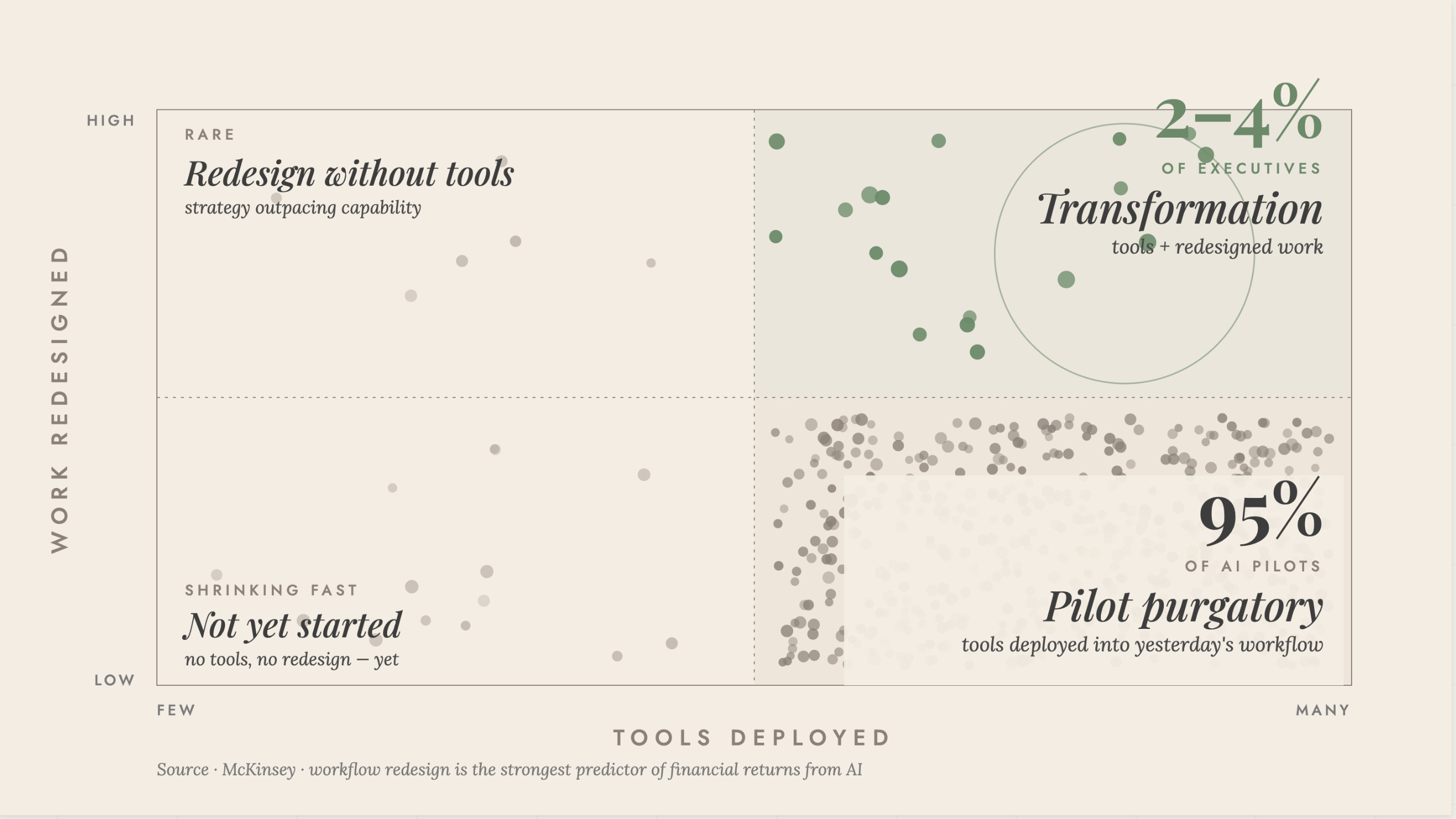
Daily AI usage has doubled since 2024. About 90% of workers are using large language models in some form. And yet only 2 to 4% of executives are seeing real, transformative organizational change. Ninety-five percent of AI pilots fail to scale.
McKinsey's research shows that workflow redesign — not tool deployment — is the strongest predictor of financial returns from AI. The organizations getting results are doing something both technologically and structurally different. They're not deploying tools into existing work — they're redesigning how work flows around what AI can actually carry.
And what AI can carry keeps changing. The capability ceiling is rising faster than most organizations can redesign around. Part of building the muscle is knowing what AI is ready to carry right now, in your specific environment — and revisiting that as the capability shifts.
The Fear Underneath the Mandate
There's something underneath the mandate that doesn't make it onto the slide deck.
The people on your team aren't afraid of AI as a tool. They're afraid of what work gives them — the income, the identity, the place in the organization they've spent years building. The rules they've been working within are changing, and no one has named the new ones yet. That fear is rational. And leaders are the one holding it for them — while simultaneously carrying the technology pressure, the results pressure, and the pace of a field that rewrites itself every few months.
Maximizing output in that environment doesn't produce transformation. It produces burnout. What people and organizations actually need is optimal performance — the right work allocated to AI, the right work kept with people, and a pace that's sustainable enough to actually move the needle.
That's the design problem. And it's the one most organizations haven't started yet.
Three Lenses
I'm Christine Reichenbach. I spent close to five years at VMware — leading Future of Work strategy for a global workforce of 37,000, then serving as Chief of Staff to the VP of HR through one of the largest tech acquisitions in history. Before that, process transformation at scale. I'm Stanford-certified in design thinking, Six Sigma trained, and for the past two years I've been building AI systems from the ground up — testing, failing, rebuilding, and teaching professionals how to lead AI transformation in their own organizations.
The organizations doing this well are treating AI as a design problem, not a deployment problem. Both the technology and the structure of work are changing. What stays constant is the need to design deliberately.
I look at every AI question through three lenses.
Design thinking: what do your customers and employees actually need? Start there. Design backward from that, with AI as one of the tools you use to deliver it. Organizations that skip this step automate the existing process and wonder why nothing meaningfully changed.
Six Sigma: how does work actually flow? You can't automate what you haven't mapped and measured. The process has to be understood before it's handed to AI. Most failed implementations skipped this work entirely.
Organizational design: who should do what — and at what pace? Not just "can AI do this" but should it? What judgment stays with people? What does AI carry? How do you manage the complexity of a field moving faster than most teams can redesign around, without burning out the people doing the moving? These decisions have to be made deliberately, or defaults fill the gap — and default settings don't optimize for people.
AI Organizational Design is what you get when all three work together. That's the piece that moves the needle — that takes AI from a tool your team uses to a capability that actually produces the outcomes and impact you're after.
One thing I've seen consistently: when people step outside their own role context — when they're solving a shared problem instead of defending their current one — the constraints drop and they discover what they're actually capable of. That's by design too.
What Intentional Design Is
Intentional Design is where I apply this publicly.
Every week: one piece of AI news or research worth your attention, run through that framework, translated into what it actually means for your business. Some weeks one article. Some weeks a few things that connect. I follow the content, not a predetermined format.
This is for business leaders and department heads who want to lead AI transformation well — not just deploy tools and hope, but redesign work deliberately, build real capability inside their teams, and make more impact with the time they have.
Beyond Business
Intentional Design isn't just a business framework for me — it's how I lead my life.
Every day I protect time that belongs to me. No output, nothing scheduled. Maybe I finally read the article that's been open in my browser all week. Maybe I need a meditation because I'm foggy, or something to get my brain back on track before the next thing. Maybe it's a random walk with a friend. I decide in the moment, based on what I actually need. Making that space is the practice.
I have three kids four and under. I live in Mesa, Arizona. Staying active and mindfulness aren't things I fit in around work — they're part of how I stay clear enough to do the work.
I mentor a teenager in foster care and helped her start her own flower business. And I'm working with other consultants to bring Intentional Design into the foster care system: better pay for workers, better outcomes for the kids we're responsible for, a system that actually moves the needle for the people who need it most.
Everything I build — this newsletter, the consulting work, the courses — comes back to one thing: helping people have more fulfilling lives. Not just more productive ones. More intentional, more impactful, more theirs.
You don't have to have your AI strategy figured out to be here. You just have to be willing to think about it differently.
I'm glad you're here.
More capable. Not more dependent.
Sources